
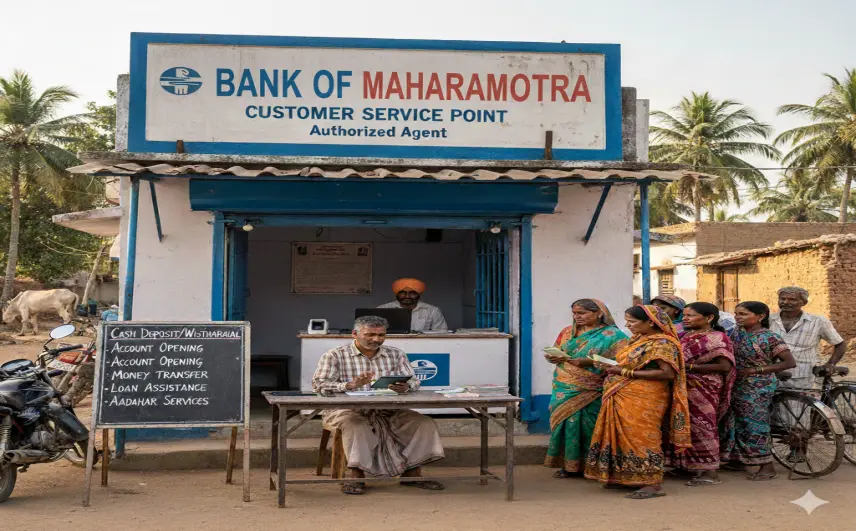
About Bank of Maharashtra CSP: How to Become a CSP Mitra
Overview of Bank of Maharashtra CSP
Bank of Maharashtra CSP, or Customer Service Point, is a strategic program under the bank's Business Correspondent (BC) model to deliver core banking services to unbanked and underbanked regions in India. As a prominent public sector bank, Bank of Maharashtra (BOM) authorizes local agents, termed CSP Mitras, to run these points as compact banking kiosks. Key offerings encompass account openings (savings, recurring, and fixed deposits), cash deposits and withdrawals, Aadhaar Enabled Payment System (AEPS) for biometric transactions, fund transfers (IMPS, NEFT, RTGS), enrollment in government schemes like PMJJBY and PMSBY, loan processing assistance, and ancillary services such as mini-statements and mobile banking setups. In 2026, the program has evolved with stronger digital integrations, including UPI linkages and enhanced security protocols, to support RBI's financial inclusion objectives. Applications are routed through empaneled BC partners like CSP Mitra Bank or NICT CSP, as direct bank applications are not available. This initiative not only generates employment for rural entrepreneurs but also ensures seamless access to financial services, with operational guidelines emphasizing penalties for downtime (e.g., Rs. 500 per day beyond 10 non-functional days) to maintain reliability. Aspiring operators should focus on areas with limited banking infrastructure for optimal success, verifying partners via BOM's official site to prevent fraud.
Steps to Apply for Bank of Maharashtra CSP
Eligibility for BOM CSP includes being 18-65 years old, holding at least a 10th-grade qualification, possessing basic computer skills, and having a secure 100-150 sq. ft. space in a viable location. The process, handled by BC partners, typically spans 3-6 weeks, including verification and training. Here's a comprehensive guide for 2026:
- Identify and Choose a BC Partner: Research BOM-empaneled providers like CSP Mitra Bank, NICT CSP, or Sahyog Co. via online searches or BOM's website. Ensure they are legitimate to avoid scams.
- Prepare Documents: Collect Aadhaar card (mandatory), PAN card, address proof (e.g., Voter ID or utility bill), educational certificates, passport photos, bank statements (last 6 months), and proof of premises (rent agreement or ownership deed).
- Submit Online Application: Access the partner's portal, select BOM CSP, fill in personal, educational, and location details, and upload scanned documents. Generate a reference number for tracking.
- Pay Initial Fees: Cover registration costs (₹5,000-₹10,000) and invest in setup (computer, biometric scanner, printer, internet), totaling ₹40,000-₹80,000.
- Verification and Inspection: The partner verifies documents, conducts credit/police checks, and performs a site visit to evaluate viability.
- Undergo Training: Attend sessions on BOM software, compliance (KYC/AML), security protocols, and customer service, provided by the partner.
- Activation and Operations: Receive CSP ID, software, and branding upon approval. Test systems and launch, adhering to guidelines like SIEM integration for logs.
Advantages of Becoming a Bank of Maharashtra CSP Operator
- Credible Income Source: Commissions up to Rs. 45 per transaction for cash operations, plus bonuses for accounts and referrals, yielding ₹15,000-₹40,000 monthly based on volume.
- Low Barrier Entry: Minimal franchise fees, with focus on infrastructure; ideal for rural entrepreneurs seeking flexible, home-based operations.
- Social Contribution: Drives financial inclusion by enabling access to schemes and services in remote areas, boosting community trust and economic activity.
- Support Ecosystem: Comprehensive training, technical helplines, and bank-backed credibility, with no fixed costs for BC appointments.
- Expansion Opportunities: Integrate add-ons like insurance sales or multi-bank services, scaling with customer growth.
Disadvantages of Becoming a Bank of Maharashtra CSP Operator
- Initial Capital Outlay: Setup costs (₹40,000-₹80,000) for equipment and space can be prohibitive in low-income zones.
- Operational Risks: Cash handling exposes to security threats; requires CCTV and safes, with penalties for downtime (Rs. 500/day after 10 days).
- Connectivity Dependencies: Relies on stable internet and power; outages in rural areas disrupt services and earnings.
- Variable Revenue: Income fluctuates with traffic and competition from digital platforms, demanding consistent marketing efforts.
- Regulatory Stringency: Strict compliance with audits and guidelines; non-adherence risks fines or suspension.