
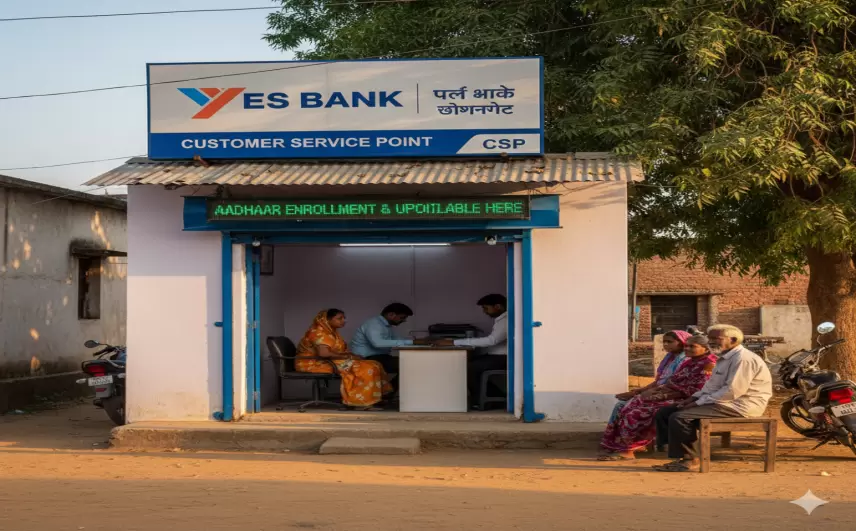
About Yes Bank CSP: How to Apply, Benefits, Drawbacks
Understanding Yes Bank CSP: A Gateway to Financial Inclusion in India
Yes Bank Customer Service Point (CSP), also known as Kiosk Banking, is an innovative initiative designed to extend banking services to underserved and rural populations across India. Launched as part of the broader financial inclusion drive, Yes Bank CSP allows authorized agents—often local entrepreneurs or individuals—to operate mini banking outlets. These points act as extensions of the bank, enabling customers to perform essential transactions without visiting a full-fledged branch. Services typically include account opening, cash deposits and withdrawals, fund transfers, bill payments, remittances, and even access to government schemes like Aadhaar-enabled payments (AEPS).
In a country where traditional banking infrastructure is limited in remote areas, Yes Bank CSP bridges the gap by leveraging technology and community-based agents. As of 2026, with India's digital economy booming, these CSPs have become vital for promoting cashless transactions and empowering low-income groups. Agents earn commissions on transactions, making it a viable business opportunity for those with basic computer skills and a small setup. However, success depends on location, customer footfall, and adherence to regulatory norms set by the Reserve Bank of India (RBI).
Steps to Apply for Yes Bank CSP
Becoming a Yes Bank CSP involves a straightforward process, but it requires meeting eligibility criteria and submitting documents. Here's a step-by-step guide based on standard procedures:
- Check Eligibility: Ensure you are at least 18 years old, have passed 10th or 12th grade, possess basic computer knowledge, and have access to a small office or shop space (at least 100-200 sq. ft.). You should also be a resident of the area you plan to serve, preferably in rural or semi-urban locations.
- Gather Required Documents: Prepare essential paperwork, including Aadhaar card, PAN card, address proof (like voter ID or utility bill), educational certificates, recent passport-sized photos (about 10), and bank account details. Some providers may require a police verification certificate or a no-objection certificate from local authorities.
- Research and Choose a Service Provider: Yes Bank often partners with third-party aggregators or business correspondents (e.g., platforms like Gramin CSP or CSP Bank Mitra). Visit their websites or contact them to understand fees, commissions, and support.
- Submit Online Application: Register on the official Yes Bank portal or a partnered platform. Fill out the application form with personal details, business plan, and preferred location. Upload scanned copies of documents.
- Pay Registration Fees: Expect to pay an initial fee ranging from ₹1,000 to ₹5,000, depending on the aggregator. This covers activation, training, and setup costs.
- Undergo Verification: A field team from Yes Bank or the partner will verify your documents, location, and setup. This may include a site visit to ensure compliance with RBI guidelines.
- Complete Training and Activation: Attend mandatory training on banking software, transaction processes, and customer service. Once approved (typically 7-14 days), receive your CSP code, login credentials, and equipment like a biometric device or POS machine.
- Start Operations: Set up your outlet with branding materials provided by Yes Bank. Begin offering services and track commissions through the portal.
Advantages of Yes Bank CSP
- Income Potential: Agents can earn ₹15,000 to ₹50,000 monthly through commissions on transactions (e.g., 0.5-2% on deposits/withdrawals), plus incentives for account openings.
- Community Impact: Contributes to financial inclusion by serving unbanked populations, earning social respect and goodwill in local areas.
- Low Investment: Minimal startup costs compared to a full business; requires only basic infrastructure and no prior banking experience.
- Flexible Operations: Run it part-time or from home/shop, with digital tools making transactions quick and secure.
- Government Support: Aligns with schemes like Pradhan Mantri Jan Dhan Yojana, offering access to subsidies and insurance products.
- Skill Development: Provides training in digital banking, enhancing employability and business acumen.
Disadvantages of Yes Bank CSP
- Location Dependency: Success relies on high footfall; rural areas may have low transaction volumes, leading to inconsistent income.
- Regulatory Compliance: Strict RBI rules mean ongoing audits, which can be time-consuming and lead to penalties for non-compliance.
- Initial Costs and Delays: Registration fees, equipment purchases, and application processing (up to 2 weeks) can be barriers for some.
- Competition: Increasing number of CSPs and digital apps (like UPI) may reduce customer visits to physical points.
- Technical Issues: Reliance on internet and software; outages can halt operations, especially in remote areas with poor connectivity.
- Limited Services: CSPs can't offer advanced products like loans or investments, restricting growth potential.