
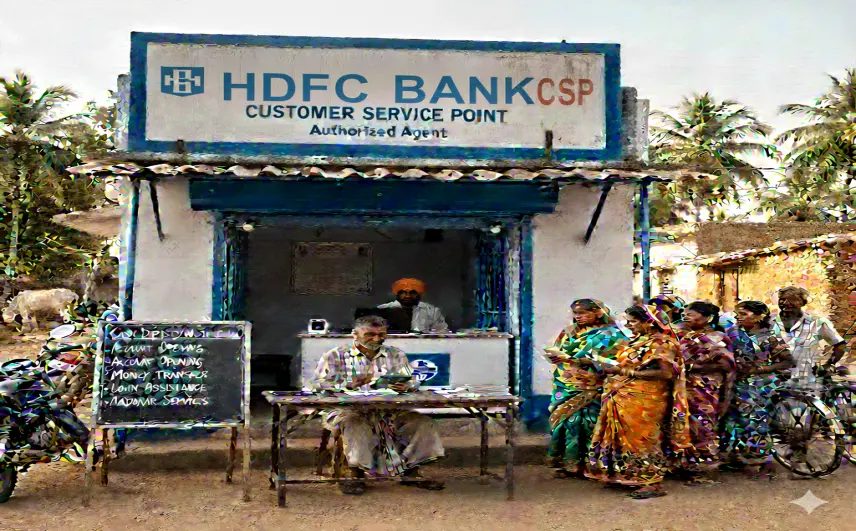
About HDFC Bank CSP: Application Steps, Benefits
Overview of HDFC Bank CSP
HDFC Bank CSP, or Customer Service Point, is a Business Correspondent (BC) program by HDFC Bank, India's largest private sector bank, designed to extend essential banking services to rural, semi-urban, and underserved areas. Agents, known as Bank Mitras, operate these kiosks to offer services including account openings (savings, current, fixed/recurring deposits), cash deposits and withdrawals (via AEPS), fund transfers (IMPS/NEFT/RTGS/UPI), bill payments, mobile/DTH recharges, loan referrals, insurance enrollments, and government subsidy disbursements. This aligns with RBI's financial inclusion guidelines, allowing local entrepreneurs to act as mini-bank outlets without needing a full branch setup.
In January 2026, HDFC Bank continues its robust CSP network post its 2022 merger with HDFC Ltd., leveraging advanced digital tools like the FedMobile app and secure biometric systems for efficient operations. Unlike public sector banks, HDFC focuses on partnerships with corporate BCs and third-party providers such as Oxigen CSP Provider, Bankmitra CSP, NICT CSP, or CSC (for VLEs), rather than direct individual registrations. This ensures scalability and support, making it attractive for entrepreneurs in high-demand regions. Prospective operators should target areas with limited banking access for optimal transaction volumes, while verifying providers to comply with HDFC's standards.
Steps to Apply for HDFC Bank CSP
HDFC Bank CSP applications are processed online through authorized third-party providers or CSC portals, with no direct individual applications on the bank's site. Eligibility: Age 18+, minimum 10th-grade education, basic digital literacy, and a small secure space (100-200 sq. ft.). The process typically takes 7-21 days, including verification.
- Choose a Reliable Provider: Select platforms like CSP Mitra Bank, SaveCSPApply, Vakrangee Bank CSP, or CSC Banking Portal that partner with HDFC Bank for CSP onboarding.
- Gather Essential Documents: Prepare Aadhaar card (mandatory), PAN card, address proof (Voter ID/utility bill/rent agreement), educational certificates, passport-sized photos, bank account details, and premises proof.
- Submit Online Application: Visit the provider's website, select HDFC Bank CSP, complete the form with personal, business, and location details, then upload scanned documents.
- Pay Registration and Setup Fees: Expect ₹5,000-₹20,000 for registration (varies; some schemes offer low/no upfront via partners). Additional costs for equipment (computer, biometric device, printer, internet): ₹20,000-₹60,000.
- Undergo Verification: The provider coordinates with HDFC Bank for document review, background/credit checks, and potential site inspection.
- Complete Training: Attend provider-led sessions on HDFC's software, compliance (KYC/AML), transaction handling, and customer service.
- Receive Activation: Get your unique CSP ID, agent portal login (e.g., via HDFC BC portal), branding materials, and start operations with real-time settlements.
Advantages of Becoming an HDFC Bank CSP Operator
- Attractive Earnings Potential: Commissions per transaction (percentage on deposits/withdrawals, fixed fees on transfers/recharges/loans), often yielding ₹15,000-₹50,000 monthly in busy locations, plus bonuses for volume and referrals.
- Prestigious Brand Association: Partnering with HDFC Bank enhances credibility, attracting customers quickly due to the bank's trusted reputation and digital reliability.
- Low Investment Flexibility: Minimal startup compared to franchises; operate from home/shops with flexible hours, ideal as a side business.
- Digital and Support Advantages: Advanced tools (UPI integration, secure portals) ensure smooth operations; providers offer training, marketing, and ongoing assistance.
- Community and Growth Impact: Contribute to financial inclusion while driving footfall to your outlet, with opportunities to diversify into insurance or multi-bank services.
Disadvantages of Becoming an HDFC Bank CSP Operator
- Upfront Costs: Total investment ₹25,000-₹80,000 for fees and equipment, which may delay profitability in low-volume areas.
- Dependency on Providers: No direct bank application; reliance on third-parties can lead to varying support quality or delays.
- Technological Vulnerabilities: Requires constant internet/power; outages common in rural setups disrupt services and earnings.
- Income Inconsistency: Earnings tied to transaction volume; competition from apps like PhonePe/Google Pay and seasonal factors cause fluctuations.
- Strict Compliance and Risks: Rigorous KYC/AML rules, audits, and cash handling increase workload and potential liability for errors.