
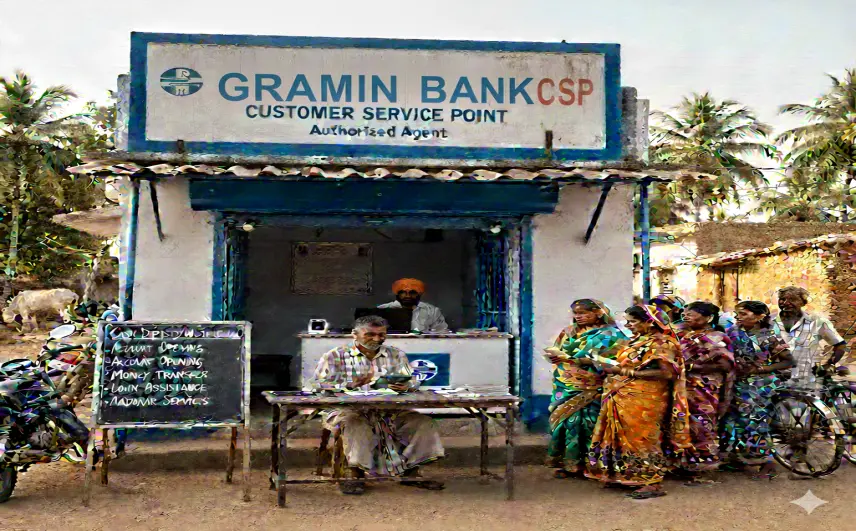
About Gramin Bank CSP: How to Apply for RRBs Customer Service Point
Overview of Gramin Bank CSP
Gramin Bank CSP refers to Customer Service Points operated under Regional Rural Banks (RRBs), also known as Gramin Banks in India. These banks, established under the Regional Rural Banks Act 1976, focus on providing credit and banking services to rural and agricultural sectors for financial inclusion. As of 2026, India has 28 consolidated RRBs operating across states, sponsored by major public sector banks like State Bank of India, Punjab National Bank, and Union Bank of India.
RRB CSPs, or Bank Mitra outlets, allow local agents to offer essential services such as account openings (savings, RD/FD), cash deposits/withdrawals via AEPS, fund transfers (IMPS/NEFT), bill payments, government scheme enrollments (e.g., PMJJBY, PMSBY), and pension disbursements. These kiosks bridge the gap in areas with limited branch access, supporting initiatives like Digital India and Pradhan Mantri Jan Dhan Yojana.
Applications for RRB CSPs are not direct but through authorized providers or corporate Business Correspondents (e.g., Oxigen CSP Provider, Bankmitra CSP, NICT CSP), as RRBs prioritize rural empowerment via partnerships. This model creates entrepreneurial opportunities while ensuring services reach underserved populations.
Steps to Apply for Gramin Bank CSP (RRBs CSP)
Applying for a CSP with a specific RRB (e.g., Baroda UP Gramin Bank, Assam Gramin Vikas Bank) involves third-party providers. Eligibility: Age 18+, minimum 10th pass, basic computer knowledge, and a small secure space in rural/semi-urban areas. Process takes 10-30 days.
- Identify the RRB and Provider — Research your local RRB (e.g., via financialservices.gov.in list) and choose affiliated providers like CSP Mitra Bank, Digital Gramin Seva, or Gramin CSP Service.
- Gather Documents — Aadhaar, PAN, Voter ID/address proof, educational certificates, passport photos, police verification, premises proof, and bank account details.
- Submit Online Application — Visit the provider's portal, select the specific RRB CSP, fill details about your location and background, and upload documents.
- Pay Fees — Registration ₹5,000-₹20,000 (varies); setup for computer, biometric scanner, printer, and internet adds ₹20,000-₹60,000.
- Verification — Provider coordinates with the RRB for background checks, credit verification, and site visit.
- Training — Complete mandatory training on RRB software, compliance, and rural banking services.
- Activation — Receive CSP ID, login, and branding; start operations with real-time settlements.
Advantages of Becoming a Gramin Bank CSP Operator
- Rural-Focused Earnings: Commissions on transactions (e.g., 0.5-1% on deposits, fixed rates for AEPS), potentially ₹10,000-₹40,000 monthly, plus incentives for scheme enrollments.
- Community Development Role: Directly support financial inclusion in villages, disbursing pensions/subsidies and promoting digital literacy.
- Low Entry & Flexibility: Minimal investment, operate from home/shop with flexible hours, ideal for local entrepreneurs.
- Government Backing: Align with national schemes, stable demand in unbanked areas, and support from NABARD/RBI-regulated RRBs.
- Diversification: Offer add-ons like recharges, loans, or multi-RRB services for higher revenue.
Disadvantages of Becoming a Gramin Bank CSP Operator
- Geographic Limitations: Primarily viable in rural areas; lower volumes in urban fringes or saturated zones.
- Infrastructure Challenges: Heavy reliance on internet/power; frequent rural outages disrupt services and earnings.
- Initial & Operational Costs: Setup expenses plus cash handling risks (need for security measures).
- Income Fluctuations: Dependent on local economy/agriculture seasons and competition from UPI/apps.
- Regulatory & Administrative Burden: Strict compliance, audits, and reporting; delays in approvals via providers.